

© Marijuana Seeds Canada | 2026


 We charge in Canadian dollars. Save 40%!
Outdoor growing looks simple: plant in spring and harvest in fall. The hard part is timing the early weeks so your seedlings don’t get hit by late frost, short spring days, or sudden sun shock. In Canada, those early mistakes matter more because many regions have a short, fast-moving season.
This guide breaks timing down like a science problem you can actually use. You’ll learn the “anchor date” method (based on frost), why day length can trigger weird growth behaviour, and how seed type changes your calendar.
A practical rule many outdoor growers follow is to move plants outside about two weeks after the last expected frost. That extra buffer matters because seedlings and young plants don’t just “bounce back” from cold stress. They often stall.
From there, you work backwards:
In many Canadian regions, that lands roughly in the late March to late April indoor-start window, with an outdoor move-in around mid-to-late May. But the most accurate plan always starts with your local frost pattern, not a national date.
Canada isn’t one outdoor season; it’s dozens. Coastal areas can have mild springs, while inland regions can get late frosts and sharp night drops. The colder and shorter your reliable warm season is, the more value you get from starting indoors. That indoor head start isn’t about making plants huge. It’s about making them mature enough to handle the later-season shift into flowering before fall weather turns.
A simple way to think about it is “usable outdoor weeks.” If your area has fewer warm weeks, you can’t afford a slow start outdoors.
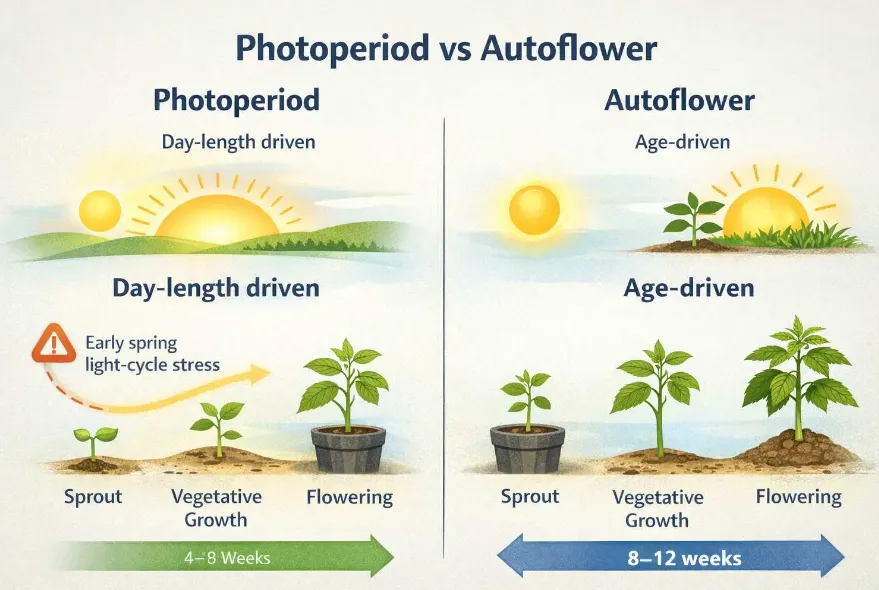
Photoperiod plants respond to day length. They stay in vegetative growth under longer days, then transition toward flowering as days shorten later in the season. That means two important things for timing:
Autoflowers are different. Many flower based on age rather than day length, with a shorter life cycle (often around 8–12 weeks from seed in typical descriptions). That makes them easier to fit into shorter seasons because you can start later and still finish before cold weather returns. Some Canadian-focused seed guidance points out that autoflowers are commonly chosen for shorter Canadian growing seasons for this reason.
Here’s a timing issue many beginners don’t expect. Putting a plant outdoors too early, when spring days are still shorter, can confuse a photoperiod plant. It may behave as if fall is coming and begin flowering early. Then, as days get longer, it can switch back into vegetative growth (“re-veg”). That back-and-forth is a stress event. Stress shows up as stalled growth, odd leaf structure, and uneven development.
This is why “two weeks after last frost” works better than “first warm weekend.” It usually lines up with more stable temperatures and more dependable day length.
Reality: Night temperatures often matter more than daytime highs for young plants. A sunny afternoon doesn’t protect seedlings from a cold night. Repeated cold nights can slow root activity and stall growth, even if the plant doesn’t die.
Reality: Starting too early can create indoor problems, like root-bound plants, stretched seedlings, or plants that outgrow your setup before outdoor weather is stable. When a plant is stressed indoors, it rarely performs its best outdoors later.
Reality: Indoor light is usually much weaker than full sun. Wind is also a constant stressor that increases water loss. A sudden move from calm indoor conditions to full outdoor exposure is a recipe for leaf bleaching, wilting, and a growth pause.
Starting seeds indoors isn’t just about convenience. It’s about controlling the most fragile stage of the plant’s life.
Indoors, seedlings are protected from heavy rain, birds, slugs, and sudden cold snaps. They also tend to build more consistent root systems because temperature and moisture are steadier. A seedling with a solid root base handles outdoor swings better. Think of it like building a foundation before you add the weather.
For beginners, indoor starting also simplifies timing. Instead of hoping outdoor conditions line up perfectly, you can start on your schedule, then move outdoors when conditions are actually stable.
Hardening off is a gradual adaptation process, usually over 7–10 days, where you slowly increase outdoor exposure. The goal is to train the plant to handle stronger light, wind, and temperature swings without shock.
A practical ramp-up looks like this:
If you skip this and put a plant straight into full sun, the plant can look “burnt” even if it’s watered. That’s often light stress, not a nutrient issue.
Use this as a starting point, then adjust based on your local frost date:
These windows are less about the calendar and more about matching plant age to stable outdoor weather.
The best time to start weed seeds for outdoor growing isn’t a single date; it’s a method. Anchor your plan to your local last expected frost date, aim to move plants outdoors about two weeks after that date, and start seeds indoors 4–8 weeks earlier. Then protect your progress by hardening plants off over about a week so they can handle real sun and wind without staling.
When you match timing to climate, day length, and seed type, outdoor growing becomes far more predictable, even in Canada’s uneven spring weather.
FAQs
A common planning method is to pick your outdoor move date at about two weeks after your last expected frost, then start seeds indoors 4–8 weeks before that. Colder, shorter-season regions often benefit from the longer end of that indoor window.
It’s usually too early if nights still drop near freezing, or if your forecast shows cold snaps. Even if afternoons are warm, repeated cold nights can stall growth and stress young plants.
You can, but it’s harder to control early-season risks like heavy rain, pests, and temperature swings. Indoor starting usually improves survival and early growth, especially for beginners.
Yes. Autoflowers often run on a shorter life cycle and are less dependent on day length, so they can be started later in the season and still finish before cold weather returns.
Re-veg is when a plant starts flowering under shorter days, then switches back into vegetative growth as days get longer. Moving photoperiod plants outdoors too early in spring can increase the risk of this stress cycle.
Hardening off reduces shock from stronger sunlight and wind. Without it, plants often stall, bleach, or wilt even when watering is fine.
Moving plants outside based on one warm day instead of stable night temperatures and frost risk. The second biggest is skipping hardening off.
People often treat planting depth like a “small detail.” In ...
Buying cannabis seeds in 2026 feels more confusing than it ...
Planting cannabis seeds sounds simple: put seed in soil, add ...
Shopping with us is 100% secure! We don’t keep personal details.

Important Links
Are You 18 Or Over?
By clicking 'Continue', you confirm that you are over 18 years old. By using this website, you agree to our terms of service.