
© Marijuana Seeds Canada | 2026


 We charge in Canadian dollars. Save 40%!
People often treat planting depth like a “small detail.” In seed biology, it’s a big lever. Depth controls how much moisture the seed can access, how much oxygen reaches the embryo, and how much work the seedling must do before it sees light. If you get depth right, many early problems disappear on their own. If you get it wrong, even healthy seeds can stall, rot, or emerge weak.
The most useful way to think about depth is this: you’re not burying a seed, you’re placing it in a thin “survival zone” where water and air are balanced. Seeds need both. Water starts germination, but oxygen powers it. Soil that stays wet and compact can suffocate a seed. Soil that dries fast can stop germination mid-process.
Most growers land in the same practical range, plant cannabis seeds 0.5 to 1 inch deep (1.3 to 2.5 cm). That depth usually provides steady moisture and darkness, while keeping the seedling’s climb short enough that it doesn’t burn through its energy reserves before reaching the surface.
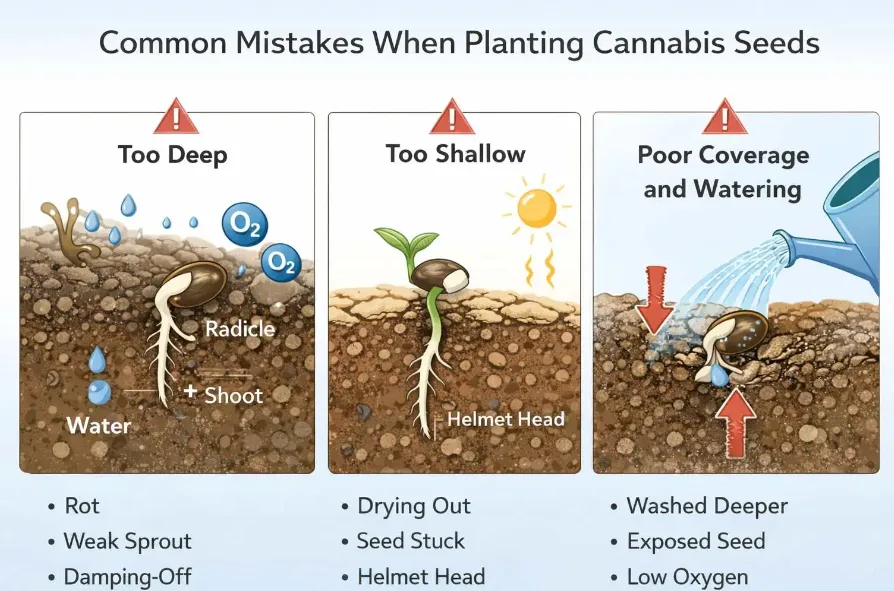
A seed is a living embryo with stored food. Once it absorbs enough water, metabolic activity ramps up. Enzymes start breaking stored nutrients into usable energy. The first root tip (radicle) pushes out and grows downward. Soon after, the shoot (the upward-growing part) begins lifting toward the surface, carrying the cotyledons (the first “seed leaves”).
Depth matters because the seedling has limited fuel for that first push. If the seed is too deep, the shoot may spend its entire energy budget lifting through heavy media. If it’s too shallow, the embryo may not stay moist long enough to complete the process.
It’s tempting to look for a single number that works every time. The reality is that depth is a range because soil is not a lab material. It varies in texture, water-holding, air space, and crusting behaviour. The best approach is to start with the golden rule, then adjust based on your medium and conditions.
Another common myth is that deeper planting “locks in moisture” and makes germination more reliable. Depth can protect from drying, but going too deep can reduce oxygen and raise disease risk. A seed that stays wet with low oxygen can fail even though the moisture looks “perfect.”
Depth is a decision you make together with your medium. Two setups can use the same seed and the same depth, then get different results because the soil behaves differently.
Heavy, fine-textured mixes (often clay-rich or overworked soils) pack tightly and can crust at the top. In these conditions, seeds should be planted slightly shallower, closer to 0.5 inch (1.3 cm), so the seedling doesn’t have to fight through a dense cap. Dense media also holds water in tiny pores, which can reduce oxygen around the seed.
Light, airy mixes (often peat/coco-based blends with perlite) keep more air pockets. They drain better and are easier for seedlings to push through. In these conditions, planting closer to 1 inch (2.5 cm) can be safe, especially if the surface dries quickly.
Think in layers. The top layer is exposed to air, so it dries fastest. The deeper layer holds moisture longer. If your surface dries within a day, a slightly deeper seed placement can protect the seed from dehydration. If your medium stays wet for days, deeper placement can keep the seed too wet for too long, lowering oxygen and raising rot risk.
A practical target is evenly moist media that feels like a wrung-out sponge. You want moisture, but you also want air.
Seed size doesn’t change the rules, but it changes how forgiving the setup is. Larger seeds often have more stored resources, so they may handle the deeper end of the range more easily. Smaller seeds usually do better on the shallow end because they have less energy to spend on the climb.
Warm environments speed evaporation at the surface. If your setup runs warm and dry, shallow seeds face a higher drying risk. Cooler environments dry more slowly but can also slow germination, meaning the seed stays in the ground longer before it emerges. A longer time underground increases exposure to microbes and inconsistent moisture.
Depth problems often look like “bad seeds,” but many are really physics problems.
A seed may germinate but never emerge. The shoot can exhaust its stored energy before reaching light. In wet, compact media, the seed can also rot because oxygen is limited. Another common outcome is a weak, pale seedling that emerges late, stretched, and fragile because it spent too long pushing upward under stress.
Shallow seeds dry out faster because the top layer loses moisture first. Germination can start and then stop, which stresses the embryo and can lead to failure. Shallow planting can also cause “helmet head,” where the seed coat stays stuck on the cotyledons. With proper depth, soil friction often helps pull the seed coat off naturally as the seedling rises.
You don’t need special tools, but you do need consistency.
Start with a clean, gentle seed-starting mix or a light potting mix. Pre-moisten it evenly before planting. If the medium is dry and you water heavily after planting, you can wash the seed deeper than planned or create soggy pockets with poor oxygen.
Use a pencil, chopstick, or your fingertip to make a hole about 0.5 inches deep as a baseline. If your medium is very light and dries quickly, you can aim closer to 1 inch. The goal is to make depth repeatable, not guessed.
Drop the seed into the hole and cover it with loose media. Avoid packing down hard. Packed soil reduces oxygen and can form a crust that makes emergence harder. A light cover keeps the seed stable while allowing air exchange.
A mist bottle or gentle watering helps keep the seed in place. Heavy watering can push the seed deeper or compact the surface. Moisture should be steady, not soaked.
A good planting depth for cannabis seeds is usually 0.5 to 1 inch (1.3 to 2.5 cm), because it balances moisture, oxygen, and a manageable path to the surface. Depth is not a magic number on its own; it’s a match between the seed and the way your medium holds water and air. Start with the golden rule, adjust slightly for soil texture and drying speed, and focus on steady moisture without waterlogging. When depth and environment work together, germination becomes less mysterious and a lot more predictable.
Both can be correct. 0.5 inch is usually safer in dense or crust-forming media. 1 inch can work well in light, fast-drying mixes. The “best” choice is the one that keeps the seed moist while still well-aerated.
It matters less than people think. Seeds have built-in responses to gravity. The radicle tends to grow downward and the shoot upward. Gentle handling and stable moisture usually matter more than which end is facing up.
Usually no. If germination has started, digging can damage the sprout. If you suspect the surface is crusted, you can gently loosen only the top layer without disturbing deeper soil. Then keep the moisture steady and give it time.
This can happen if the seedling is weak from emerging late, if the stem stretches due to low light after emergence, or if the soil line stays too wet. Depth can be part of the story, but so can watering, surface airflow, and light once the sprout appears.
Helmet head happens when the seed coat stays stuck to the cotyledons. It’s more common with shallow planting, low humidity, or a surface that dries too quickly. Often, the seedling resolves it on its own as it grows.
Timing varies with temperature, moisture, and seed condition. A warmer, stable environment usually shortens the timeline. A cooler setup can take longer. The key is resisting the urge to dig and “check,” since that can do more harm than waiting.
Outdoor growing looks simple: plant in spring and harvest in ...
Buying cannabis seeds in 2026 feels more confusing than it ...
Planting cannabis seeds sounds simple: put seed in soil, add ...
Shopping with us is 100% secure! We don’t keep personal details.

Important Links
Are You 18 Or Over?
By clicking 'Continue', you confirm that you are over 18 years old. By using this website, you agree to our terms of service.